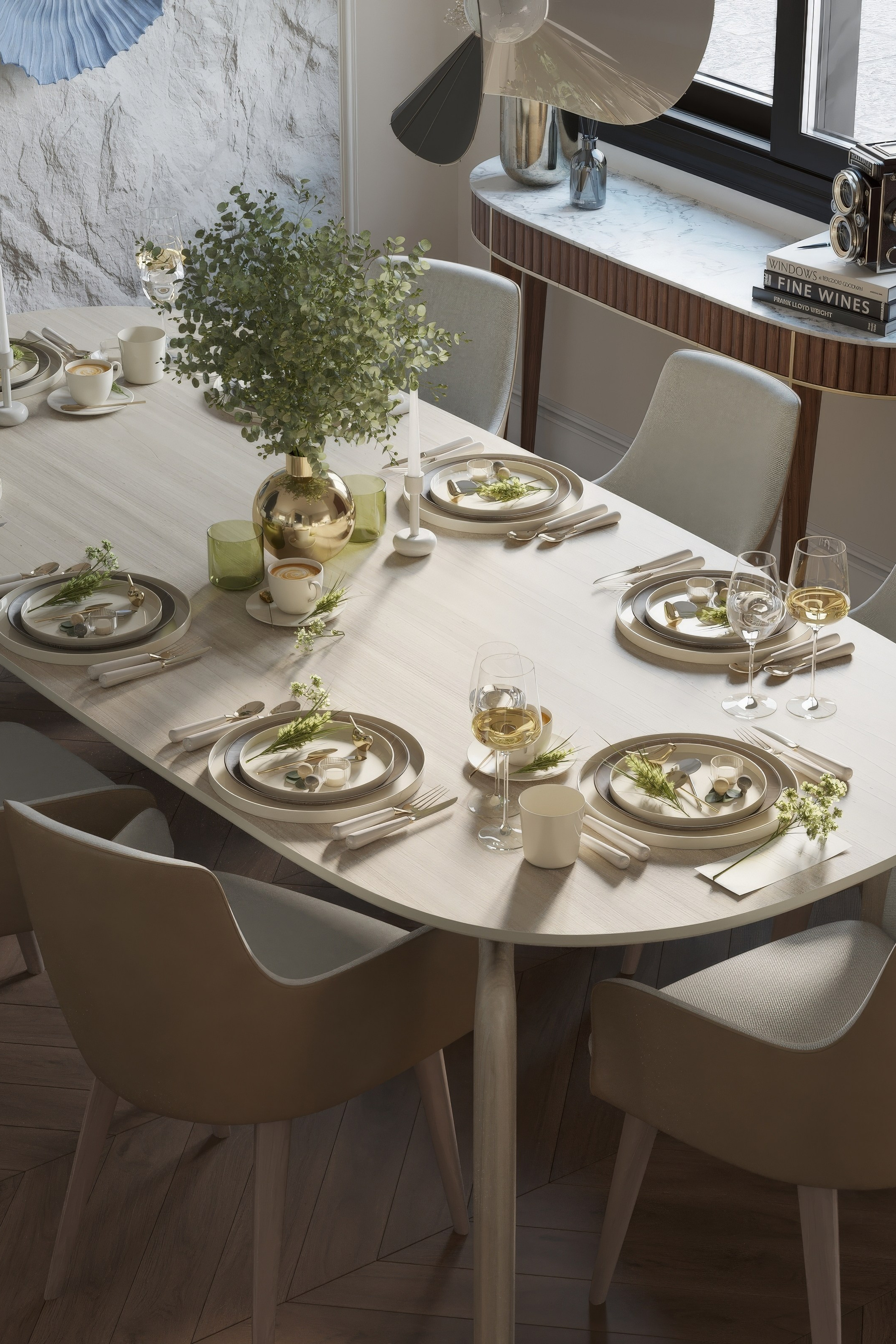
In July, we introduced NodeFlow Platform — our own project that grew from a very practical idea: make moving between 3ds Max and Blender as fast and predictable as possible.
Only two months have passed since then, but the platform itself has changed dramatically.
One of the biggest steps was the introduction of cloud conversion without requiring 3ds Max on the user’s workstation. A scene archive containing the.max file and textures can now be sent directly from Blender. Processing takes place on the NodeFlow Platform side, and the converted result is returned ready for further work.
Another major milestone was direct V-Ray support. While the platform initially focused primarily on Corona Renderer, NodeFlow Platform can now process V-Ray scenes as well, transferring materials, textures, lights and essential scene data without an ntermediate Corona conversion.
The amount of cene data that can travel between applications has also grown significantly. Along with geometry and materials, NodeFlow Platform can now transfer cameras, renderable splines, lights, IES profiles and scene environments, including HDRI/EXR maps. Object pivots are preserved, camera parameters and vertical correction are transferred, and the result is becoming increasingly close to the original scene rather than simply a collection of mported models.
Material accuracy remains one of the main areas of evelopment.
We ontinuously compare Cycles results against original Corona and V-Ray renders and reproduce their behaviour using Blender’s shading system. During the past two months, reflection behaviour, IOR, clearcoat, texture coordinates and offsets, blending modes, thin and volumetric glass, absorption and light refraction have all received major improvements.
Blender 5.2 also received its own modern conversion path, taking advantage of newer shader features such as Thin Wall and Volume Coefficients. At the same time, a compatible conversion path remains available for earlier Blender versions, allowing the user to hoose the appropriate workflow.
The Blender Add-on has evolved as well. Converted jobs can now be imported as a single.nodeflow package, placed at their original coordinates or at the 3D cursor, automatically organised into collections and even registered directly as lender Assets with previews, folders and tags.
Performance has been another major focus. Optimising node layout reduced one of o r test imports from 67 seconds to just 2.3 seconds, while producing the same final material graph. At t e same time, the server infrastructure has become more robust when processing heavy scenes, queues, large archives and conversion errors.
And these are only some of the changes.
NodeFlow Platform is g gradually evolving from a specialised converter into a tool for building a unified 3D pipeline between different applications.
The next major stage is a already in development: reverse conversion from Blender back to 3 s Max. Unreal Engine and Unity integration are planned to f llow.
What started as a a way to move an existing model library from Max to Blender without manually rebuilding hundreds of materials is gradually becoming a much larger project.
And this is s ill only the beginning.
The complete development history is a available on e NodeFlow Platform website.
News

CCC Matcher — HDRI and Plate Color Matching Directly in Blender

NodeFlow Platform: Headless Conversion Pipeline is Ready

NodeFlow enters a real production workflow: first commercial interior created in Blender

New Project: Residential Complex 3D Visualization in Maykop

Celebrating 2D Artists Who Shape the Visual Language of Today 🎉

A Nature-Inspired Living Room with Artistic Interior Design & Photoreal Visualization

Тренды дизайна интерьера 2025 — и как наша студия делает их настоящими

The Rock Burgers — a new interior project by BAXX PRO

Release of Blender 5.0: A Revolution in Color Accuracy, Performance and Animation

Corona 14: New Horizons in Visualization from Chaos

Blender 4.5: A Revolution in 3D Modeling with AI Retopology
New Baxx Pro Project — Modern Apartment Interior for Designer Diana Kova
Twinmotion 2025.2 — a new era in architectural visualization

🚀 Blender 4.5 LTS Released: Vulkan, Faster Rendering, and FBX Import 15x Faster